Tuesday, 14 June 2011

Air Strike on Iran Nuclear Assets Possible Now


When I posted two or three weeks ago that an American supported Israeli air strike was possibly eminent because the necessary assets had moved in place, I still lacked the reason as to why just now. This tells us why it will happen now. Assume Russia will arrange to be standing by for this one and to also be in the know. They may be selling a reactor, but they want a nuclear weapon in these fool’s hands no more than we do. Think of the rich targets for Islam in Russia.

A surgical strike is likely to happen this week. The purpose will be to smash up the reactor itself. The only interesting question is how the Iranian air force will be neutralized while the attack goes in, particularly if they wish to have a back up wave. I assume the US will not be visible.

Iran’s reaction will be of serious interest. The most damaging thing that they could do in the short term is to suspend oil shipments to the extent that they can. This could precipitate a jump in oil prices to the $150 mark and generate a sharp decline in stock prices. That though should be the most effect their actions may have.

In the medium term, regime control of the population will likely spiral out of control because the population will immediately blame the regime for bringing this attack on to themselves. Discontent is also likely to become visible in the armed forces because of the regime’s reckless behavior and proven futility. In short, the regime will be destabilized.

Beyond what we have just described, they have no creditable response.

I note from this map that the reactor is on the Persian Gulf itself. Any attack seems way more difficult and may target the secondary assets instead. In the event, we have reached a decision point.


John Bolton: Russia's Loading of Nuke Fuel Into Iran Plant Means Aug. 21 Deadline for Israeli Attack

Friday, 13 Aug 2010 01:41 PM
By: David A. Patten


News that Russia will load nuclear fuel rods into an Iranian reactor has touched off a countdown to a point of no return, a deadline by which Israel would have to launch an attack on Iran's Bushehr reactor before it becomes effectively "immune" to any assault, says former Bush administration U.N. Ambassador John R. Bolton.

Once the fuel rods are loaded, Bolton told Fox News on Friday afternoon, "it makes it essentially immune from attack by Israel. Because once the rods are in the reactor an attack on the reactor risks spreading radiation in the air, and perhaps into the water of the Persian Gulf."

Russian Prime Minister Vladimir Putin declared in March that Russia would start the Bushehr reactor this summer. But the announcement from a spokesman for Russia's state atomic agency to Reuters Friday sent international diplomats scrambling to head off a crisis.

The story immediately became front-page news in Israel, which has laid precise plans to carry out an attack on Iran's nuclear facilities while going along with President Obama's plans to use international sanctions and diplomatic persuasion to convince Iran's clerics not to go nuclear.

Bolton made it clear that it is widely assumed that any Israeli attack on the Bushehr reactor must take place before the reactor is loaded with fuel rods.

"If they're going to do it that's the window that they have," Bolton declared. "Otherwise as I said before, once the rods are in the reactor, if you attack the reactor you're going to open it up and radiation will escape at least into the atmosphere and possibly into the waters of the Persian Gulf.


"So most people think that neither Israel nor the United States, come to that, would attack the reactor after it's been fueled."

Bolton cited the 1981 Israeli attack on Saddam Hussein's Osirak reactor outside Baghdad and the September 2007 Israeli attack on a North Korean reactor being built in Syria. Both of those strikes came before fuel rods were loaded into those reactors.

"So if it's going to happen in Bushehr it has to happen before the fuel rods go in," Bolton said.

The conversation that touched off the de facto deadline for Israeli military action was a telephone conversation with wire services involving Sergei Novikov, a spokesman for Rosatom, the Russian Energy State Nuclear Corp.

Novikov said: "The fuel will be loaded on Aug 21. This is the start of the physical launch” of the reactor.

"From that moment the Bushehr plant will be officially considered a nuclear-energy installation," Novikov said, adding that the head of Rosatom, Sergei Kiriyenko, will visit Bushehr Aug. 21 to conduct a ceremony for the event.
According to Bolton, once the reactor is operational, it is only a matter of time before it begins producing plutonium that could be used in a nuclear weapon.

"And in the normal operation of this reactor, in just a fairly short period of time, you could get substantial amounts of plutonium to use as nuclear weapons," Bolton told Fox.

Russia, which is operating under a $1 billion contract with Iran, has spent more than a decade building the reactor. If Russia moves forward with its plan to fuel the reactor, it could be seen as a major setback to the Obama administration's strategy of engaging Russian leaders in order to win their cooperation.

"The U.S. urged them not to send the Iranian's fuel rods," Bolton said. "They did that. The Obama administration has urged them not to insert the fuel rods in the reactors, but as they've just announced that will begin next week. What that does over time is help Iran get another route to nuclear weapons through the plutonium they could reprocess out of the spent fuel rods."

The developments mean Israeli Prime Minister Benjamin Netanyahu soon may face a stark choice: Attack the Bushehr reactor in the next 8 days, or allow it to become operational despite the certainty it would greatly enhance Iran's ability to create nuclear weapons.

Russian leaders have said the Bushehr reactor project is being closely monitored by the International Atomic Energy Agency (IAEA), the UN's nuclear watchdog group. According to Iran's ISNA news agency, IAEA inspectors will be on hand to observe the fuel-rod loading process that is now scheduled to begin Aug. 21.

According to Russian officials, Iran has promised in writing to send all spent fuel rods from Bushehr back to Russia for reprocessing, to ensure they cannot be used for nuclear weapons.


Bolton said the reactor has been "a hole" in American foreign policy for over a decade.

The failure to demand it be shut down began in the Bush years, he said, and continues with the Obama administration "under what I believe is the mistaken theory that Iran is entitled to the peaceful use of nuclear energy."

"I don't think Iran is entitled to that, or I don't think we ought to allow it to happen, because they're manifestly violating any number of obligations under the non-proliferation treaty not to seek nuclear weapons. But this has been a hole in American policy for some number of years, and Iran and Russia are obviously exploiting it," Bolton said.

Russia’s move would put Iran "in a much better position overall," he said, adding, "I think this is a very delicate point, as I say, it closes off to the Israelis one possible target for pre-emptive military action.

U.N. sanctions against Iran, he said, "have not had and will not have any material effect on Iran's push to have deliverable nuclear weapons."

Sunday, 12 June 2011

Stephen Hawking Call to Escape Earth


This is all good fun and it is stating the obvious. However, we have plenty of good options. As developed in this blog, simply terraforming Earth will make it full habitable for a population base well over fifty billion while sustaining a bio-rich ecology. Our biggest stretch will be to deploy the Eden machine.

Then there is the little matter of Venus, nicely prepositioned for been terraformed by our selves. It is merely a matter of diverting plenty of comets into the planet. Once we have the MEV (magnetic exclusion vessel) available for space travel this will be straight forward engineering and may well have been fully underway for the past ten millennia.

After that we get to build space habitats that are a good mile across and are spun up to provide artificial gravity. Any one perhaps can be designed to hold and support a 100 million in population in complete comfort. Ten thousand of those in the asteroid belt would still be lost and invisible to our scopes with minimum effort.

The point I am making is that we can place fifty billion on Earth, fifty billion of Venus and a hundred times that out in the Asteroid Belt long before we have to think about other stars.

The only thing technically needed yet is the MEV. We have the know how to do it all now. The MEV will take perhaps another twenty years or less. I have already described the tech and the key benchmarks in earlier articles and posts.


Stephen Hawking's Warning: Abandon Earth—Or Face Extinction
Andrew Dermont on August 6, 2010, 12:00 AM


Let's face it: The planet is heating up, Earth's population is expanding at an exponential rate, and the the natural resources vital to our survival are running out faster than we can replace them with sustainable alternatives. Even if the human race manages not to push itself to the brink of nuclear extinction, it is still a foregone conclusion that our aging sun will expand and swallow the Earth in roughly 7.6 billion years.
So, according to famed theoretical physicist Stephen Hawking, it's time to free ourselves from Mother Earth. "I believe that the long-term future of the human race must be in space," Hawking tells Big Think. "It will be difficult enough to avoid disaster on planet Earth in the next hundred years, let alone the next thousand, or million. The human race shouldn't have all its eggs in one basket, or on one planet. Let's hope we can avoid dropping the basket until we have spread the load."

Hawking says he is an optimist, but his outlook for the future of man's existence is fairly bleak. In the recent past, humankind's survival has been nothing short of "a question of touch and go" he says, citing the Cuban Missile Crisis in 1963 as just one example of how man has narrowly escaped extinction. According to the Federation of American Scientiststhere are still about 22,600 stockpiled nuclear weapons scattered around the planet, 7,770 of which are still operational. In light of the inability of nuclear states to commit to a global nuclear non-proliferation treaty, the threat of a nuclear holocaust has not subsided.

In fact, "the frequency of such occasions is likely to increase in the future," says Hawking, "We shall need great care and judgment to negotiate them all successfully."


Even if humans manage to avoid a nuclear stand-off over the next thousand years, our fate on this planet is still pretty much certain. University of Sussex astrophysicist Dr. Robert Smith says eventually the aging Sun will accelerate global warming to a point where all of Earth's water will simply evaporate.

"Life on Earth will have disappeared long before 7.6 billion years," says Smith, "Scientists have shown that the Sun's slow expansion will cause the temperature at the surface of the Earth to rise. Oceans will evaporate, and the atmosphere will become laden with water vapor, which (like carbon dioxide) is a very effective greenhouse gas. Eventually, the oceans will boil dry and the water vapor will escape into space. In a billion years from now the Earth will be a very hot, dry and uninhabitable ball."

Finally, between the next thousand years or so that Hawking says it will take man to make the planet uninhabitable and the billion years it will take for the sun to turn our planet into an arid wasteland, there is always the chance that a nearby supernova, an asteroid, or aquick and painless black hole could do us in.
Takeaway

One way or another, the life on Earth will likely become uninhabitable for mankind in the future. We need to start seriously thinking about how we will free ourselves from the constraints of this dying planet.

Why We Should Reject This Idea

Despite what Hawking describes as humankind's "selfish and aggressive instinct," there may be some biological impediments to finding another planet to inhabit.

"The nearest star [to Earth] is Proxima Centauri which is 4.2 light years away," saysUniversity of Michigan astrophysicist Katherine Freese, "That means that, if you were traveling at the speed of light the whole time, it would take 4.2 years to get there."

Unfortunately, at the moment we can only travel at about ten thousandth of light speed, which means if man were to use chemical fuel rockets similar to the those used during the Apollo mission to the moon, the journey would take about 50,000 years. Without the use of a science-fiction-like warp drive or cryogenic freezing technology, no human would live long enough to survive the journey. In addition, "the radiation you would encounter alone would kill you, even if you could get a rocket to go anywhere near that fast," says Freese.

On the upside, if man ever develops the technology to travel at the speed of light while remaining shielded from cosmic radiation, he could effectively travel into the future. "A five year trip at light speed could push an astronaut forward by 1000 earth years," says Freese, "If he wanted to see if any humans were still around by then."


Sunday, 5 June 2011

See Through Solar Panels


This is interesting though I would like to see more detail. The use of organics asks more questions than it answers. That it can out perform thin film by an order of magnitude implies converting over a much broader spectrum. So far so good. Can it be sustained?

This is a new entrant and the claims are at least promising. Even if the production is nort particularly impressive, it will still have a market merely to make use of a passive resource. Recall windows must be specially made to begin with, and it will be no trick at all folding this into the supply chain.

Of course, if they can establish sustainable high yield at a low effective cost base, every office building will soon convert and so will everyone else. Recall how we all use double pane windows these days.


World's First-of-Its-Kind See-Thru Glass SolarWindow Capable Of Generating Electricity

by Staff Writers

Burtonsville MD (SPX) Jul 27, 2010


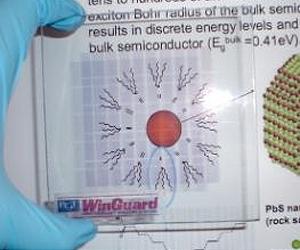
Researchers Apply Coating to Commercial Glass, Demonstrating Transparency of New Energy's SolarWindow Capable of Generating Electricity, Currently Under Development. Source: New Energy Technologies, Inc.


New Energy Technologies is pleased to announce that researchers developing its proprietary SolarWindow technology have achieved major scientific and technical breakthroughs, allowing the Company to unveil a working prototype of the world's first-ever glass window capable of generating electricity in the upcoming weeks.

Until now, solar panels have remained opaque, with the prospect of creating a see-thru glass window capable of generating electricity limited by the use of metals and various expensive processes which block visibility and prevent light from passing through glass surfaces.

New Energy's ability to generate electricity on see-thru glass is made possible by making use of the world's smallest working organic solar cells, developed by Dr. Xiaomei Jiang at the University of South Florida. Unlike conventional solar systems, New Energy's solar cells generate electricity from both natural and artificial light sources, outperforming today's commercial solar and thin-film technologies by as much as 10-fold.

New Energy's SolarWindow technology is under development for potential application in the estimated 5 million commercial buildings in America (Energy Information Administration) and more than 80 million single detached homes.

"We're always keen to see innovations in our laboratories turn into meaningful commercial products," stated Valerie McDevitt, Assistant Vice President for Research, Division of Patents and Licensing, University of South Florida. "We very much look forward to the commercial development of New Energy's SolarWindow technology, which, if successful, could literally transform the way in which we view the use of solar energy for our homes, offices, and commercial buildings."

The University of South Florida Research Foundation has licensed Dr. Xiaomei Jiang's groundbreaking discovery and important commercial processes and applications to New Energy Solar Corporation, a wholly-owned subsidiary of New Energy Technologies, Inc.

"It's very exciting to see that our ongoing research has led to several significant breakthroughs with transparency and the production of electricity on see-thru glass," explained Mr. Meetesh V. Patel, President and CEO of New Energy Technologies, Inc. "For the first time ever, these advances have allowed us to develop an early-scale working prototype of the technology, which I very much look forward to unveiling in the upcoming weeks."

Thursday, 2 June 2011

Burger chain climate change whopper

Burger chain's climate change whopper

Tennessee outlets ended up eating humble pie after a local reporter spotted 'rogue' signs outside Burger King outlets

Burger King Calls Global Warming 'Baloney' reports by the Memphis Flyer

Burger King outlets in Tennessee calls global warming 'baloney'. Photograph: www.memphisflyer.com

Would you like a side order of climate denial with your flame-broiled Triple Whopper? If so, then you need to get yourself over to Tennessee where a number of Burger King franchises in the US state that gave us Al Gore have been displaying "Global Warming is Baloney" signs outside their fast-food restaurants.

Chris Davis, a staff writer for the Memphis Flyer, a local newsweekly, noticed the signs outside two Burger Kings in the city last week and decided to put in a call to one of the restaurants to inquire whether such a view was now official Burger King policy. Here's his transcript of the call…

Davis: Hi, I'm calling from the Flyer about your sign. Does Burger King really think global warming is baloney?
BK: [Hang-up]
Davis: [Calling back]: Your sign out front says global warming is baloney.
BK: I don't see that, sir.
Davis: Well, it does.
BK: I don't see that sir... I change the signs and that sign's been up for a week.
Davis: Well, I have pictures that I took this afternoon…So, there's no question that your sign said it and so did one in Midtown. I want to know if it was on purpose, or if it was a prank someone pulled on you.
BK: Let me get the manager. [several minutes of dead air then the same or very similar voice picks up.]
BK: Who were you holding for?
Davis: A manager, about the sign. I have pictures of the sign and people have called me upset. I just want to know if it's a mistake or not so I can report it.
BK: Let me go outside and look at the sign and I'll call you right back. [exchange of contact info]
[Phone rings, Davis answers]
BK: The sign was put up yesterday.
Davis: And it's not a mistake?
BK: No.
Davis: It reflects the opinion of BK international?
BK: Yes. Would you like to talk to the home office? I can give you a number.
Davis: I've got the number, I've already contacted them. Thanks.

A few days pass before Davis hears back from someone higher up the food chain at Burger King. Last Friday, he finally received an email from Susan Robison, the vice president of corporate communications at the Burger King Corporation:

This statement ["Global Warming is baloney"] does not reflect a Burger King Corp. (BKC) opinion or view. The two restaurants where these signs appeared are independently owned and operated and were not authorized to display this statement. The signs have since been removed. BKC believes in operating as a socially responsible company and is committed to making a positive impact in the communities where it lives and works.

One imagines that someone at Burger King realised that the "global warming is baloney" line didn't exactly chime with the views of John Chidsey, the company's CEO, who believes that climate change is "an overriding issue of importance for the global community, business community and people in general", as he stated in this short interview conducted at this year's World Economic Forum. (How he squares this concern with his company's drive-thru, meat-munching business model is another matter, though.)

Memphis Flyer readers have been contacting the paper since the story first appeared to say that they have noticed other restaurants across Tennessee displaying the same sign. It appears that they are all owned by a company called the Mirabile Investment Corporation (MIC) that owns more than 40 Burger Kings across Tennessee, Arkansas and Mississippi, as well as a handful of Popeyes and All In One franchises. Some readers have added that the signs are still up at some of the restaurants. Davis says he has requested a response from MIC, but has not yet received one.

I applaud their honesty, though. I think we should know what a restaurant's position is on the key issues of the day before we choose to step across their threshold. Let's go the full hog – I want to know their views on immigration, cap and trade, MPs expenses, schooling, the Middle East's roadmap, Susan Boyle and stem cell research before I even reach the menu board outside. Maybe there's room in the fast-food sector for a politically-themed chain of restaurants? How about we call it Hard To Swallow?

Wednesday, 25 May 2011

Ocean current switch due to warming could be slower than feared

CHICAGO — The nightmare global warming scenario which provided the plot for a Hollywood blockbuster -- the Atlantic Ocean current that keeps Europe warm shuts down and triggers rapid climate change -- has long worried scientists.

But a study published Thursday in the journal Science found it may not occur as quickly as previously feared.


There is evidence that this current has shut down with some regularity in the past -- and sometimes quite rapidly -- in response to large influxes of fresh water from melting glaciers.

However, it appears as though the current rate of glacial melt is occurring at a more gradual pace which will "give ecosystems more time to adjust to new conditions," said study coauthor Peter Clark, a professor of geosciences at Oregon State University.

Article continues

Wednesday, 11 May 2011

Nerve Regeneration Breakthrough


This is the first real news related to regeneration that is really important. Stem cell work up to now faced the brick wall of nerve recovery. Now all folks suffering nerve damage can become nervously optimistic and really look forward to leaving their wheelchairs.

Nothing is so important.

This also makes it possible to completely regenerate a fresh set of teeth sooner or later.

In fact all forms of regeneration now become plausible. This was merely a dream until a nerve generation protocol arose.

So we can legitimately hold out hope to anyone hanging on through major physical damage.

In breakthrough, nerve connections are regenerated after spinal cord injury

Researchers from UCI, UCSD and Harvard deleted a cell growth inhibitor called PTEN

Irvine, Calif., August 8, 2010 —


Researchers for the first time have induced robust regeneration of nerve connections that control voluntary movement after spinal cord injury, showing the potential for new therapeutic approaches to paralysis and other motor function impairments.

In a study on rodents, the UC Irvine, UC San Diego and Harvard University team achieved this breakthrough by turning back the developmental clock in a molecular pathway critical for the growth of corticospinal tract nerve connections.

They did this by deleting an enzyme called PTEN (a phosphatase and tensin homolog), which controls a molecular pathway called mTOR that is a key regulator of cell growth. PTEN activity is low early during development, allowing cell proliferation. PTEN then turns on when growth is completed, inhibiting mTOR and precluding any ability to regenerate.

Trying to find a way to restore early-developmental-stage cell growth in injured tissue, Zhigang He, a senior neurology researcher at Children’s Hospital Boston and Harvard Medical School, first showed in a 2008 study that blocking PTEN in mice enabled the regeneration of connections from the eye to the brain after optic nerve damage.

He then partnered with Oswald Steward of UCI and Binhai Zheng of UCSD to see if the same approach could promote nerve regeneration in injured spinal cord sites. Results of their study appear online in Nature Neuroscience.

“Until now, such robust nerve regeneration has been impossible in the spinal cord,” said Steward, anatomy & neurobiology professor and director of the Reeve-Irvine Research Center at UCI. “Paralysis and loss of function from spinal cord injury has been considered untreatable, but our discovery points the way toward a potential therapy to induce regeneration of nerve connections following spinal cord injury in people.”

According to Christopher & Dana Reeve Foundation data, about 2 percent of Americans have some form of paralysis resulting from spinal cord injury, which is due primarily to the interruption of connections between the brain and spinal cord.

An injury the size of a grape can lead to complete loss of function below the level of injury. For example, an injury to the neck can cause paralysis of arms and legs, loss of ability to feel below the shoulders, inability to control the bladder and bowel, loss of sexual function, and secondary health risks including susceptibility to urinary tract infections, pressure sores and blood clots due to an inability to move the legs.

“These devastating consequences occur even though the spinal cord below the level of injury is intact,” Steward noted. “All these lost functions could be restored if we could find a way to regenerate the connections that were damaged.”

He and his colleagues are now studying whether the PTEN-deletion treatment leads to actual restoration of motor function in mice with spinal cord injury. Further research will explore the optimal timeframe and drug-delivery system for the therapy.

Kai Liu, Yi Lu, Andrea Tedeschi, Kevin Kyungsuk Park, Duo Jin, Bin Cai, Bengang Xu and Lauren Connolly of Harvard; Jae Lee of UCSD; and Rafer Willenberg and Ilse Sears-Kraxberger of UCI also contributed to the study, which was supported by the Wings for Life Spinal Cord Research Foundation, the Craig H. Neilsen Foundation, the International Spinal Research Trust, the National Institute of Neurological Disorders & Stroke, and a private contribution to the Reeve-Irvine Research Center.

Sunday, 1 May 2011

Ellen Brown on the Sovereign Debt Trap


I have to thank Ellen Brown for digging up some of the history of State reserve banking through the past century which has been often clouded with misrepresentations and sheer ignorance even among supposed insiders.

Read this and ponder. Today our private banking system has blown them selves up and is struggling to return to a sound capital base. This makes it difficult to expand. We most need the States to form State banks and deposit the States cash resources therein while promoting citizen deposits also. The mortgage business alone would support this base.

At least this continues to show a way forward in this era of banking crisis.

Escaping the Sovereign Debt Trap: The Remarkable Model of the Commonwealth Bank of Australia

By Ellen Brown


The current credit crisis is basically a capital crisis: at a time when banks are already short of the capital needed to back their loans, capital requirements are being raised. Nearly a century ago, the Commonwealth Bank of Australia demonstrated that banks do not actually need capital to make loans – so long as their credit is backed by the government. Denison Miller, the Bank’s first Governor, was fond of saying that the Bank did not need capital because “it is backed by the entire wealth and credit of the whole of Australia .” With nothing but this national credit power, the Commonwealth Bank funded both massive infrastructure projects and the country’s participation in World War I.

President John Adams is quoted as saying, “There are two ways to conquer and enslave a nation. One is by the sword. The other is by debt.” The major conquests today are on the battlefield of debt, a war that is raging globally. Debt forces individuals into financial slavery to the banks, and it forces governments to relinquish their sovereignty to their creditors, which in the end are also private banks, the originators of all non-cash money today. In Great Britain , where the Bank of England is owned by the government, 97% of the money supply is issued privately by banks as loans. In the U.S. , where the central bank is owned by a private consortium of banks, the percentage is even higher. The Federal Reserve issues Federal Reserve Notes (or dollar bills) and lends them to other banks, which then lend them at interest to individuals, businesses, and local and federal governments.

That is true today, but in the past there have been successful models in which the government itself issued the national currency, whether as paper notes or as the credit of the nation. A stellar example of this enlightened approach to money and credit was the Commonwealth Bank of Australia , which operated successfully as a government-owned bank for most of the 20th century. Rather than issuing “sovereign debt” – federal bonds indebting the nation to pay at interest in perpetuity – the government through the Commonwealth Bank issued “sovereign credit,” the credit of the nation advanced to the government and its constituents.

The Bank’s achievements were particularly remarkable considering that for its first eight years, from 1912 to 1920, it did not have the power to issue the national currency, and it operated without startup capital. Sir Denison Miller, Governor of the Bank from its creation in 1912 to 1923, was quoted in the Australian Press on July 7, 1921 as saying, “The whole of the resources of Australia are at the back of this bank, and so strong as this continent is, so strong is the Commonwealth Bank. Whatever the Australian people can intelligently conceive in their minds and will loyally support, that can be done.”


This was not just hype. In a 2001 article titled “How Money Is Created in Australia ,” David Kidd wrote of the Bank’s early accomplishments:

Australia ’s own government-established Commonwealth Bank achieved some impressive successes while it was ‘the peoples’ bank’, before being crippled by later government decisions and eventually sold. At a time when private banks were demanding 6% interest for loans, the Commonwealth Bank financed Australia ’s first world war effort from 1914 to 1919 with a loan of $700,000,000 at an interest rate of a fraction of 1%, thus saving Australians some $12 million in bank charges. In 1916 it made funds available in London to purchase 15 cargo steamers to support Australia ’s growing export trade. Until 1924 the benefits conferred upon the people of Australia by their Bank flowed steadily on. It financed jam and fruit pools to the extent of $3 million, it found $8 million for Australian homes, while to local government bodies, for construction of roads, tramways, harbours, gasworks, electric power plants, etc., it lent $18.72 million. It paid $6.194 million to the Commonwealth Government between December, 1920 and June, 1923 - the profits of its Note Issue Department - while by 1924 it had made on its other business a profit of $9 million, available for redemption of debt. The bank’s independently-minded Governor, Sir Denison Miller, used the bank’s credit power after the First World War to save Australians from the depression conditions being imposed in other countries. . . . By 1931 amalgamations with other banks made the Commonwealth Bank the largest savings institution in Australia , capturing 60% of the nation’s savings.”

Harnessing the Secret Power of Banking for the Public Good

The Commonwealth Bank was able to achieve so much with so little because both its first Governor, Denison Miller, and its first and most ardent proponent, King O’Malley, had been bankers themselves and knew the secret of banking: that banks create the “money” they lend simply by writing accounting entries into the deposit accounts of borrowers.


This banking secret was confirmed by a number of early banking insiders. In a 1998 paper titled “Manufacturing Money,” Australian economist Mike Mansfield quoted the Rt. Hon. Reginald McKenna, former Chancellor of the Exchequer, who told shareholders of the Midland Bank on January 25, 1924, “I am afraid the ordinary citizen will not like to be told that the banks can, and do, create and destroy money. The amount of money in existence varies only with the action of the banks in increasing or decreasing deposits and bank purchases. We know how this is effected. Every loan, overdraft or bank purchase creates a deposit, and every repayment of a loan, overdraft or bank sale destroys a deposit.”


Dr. Coombs, former Governor of the Reserve Bank of Australia , said in an address at Queensland University on September 15, 1954, “[W]hen money is lent by a bank it passes into the hands of the person who borrows it without anybody having less. Whenever a bank lends money there is therefore, an increase in the total amount of money available.”


Ralph Hawtrey, Assistant Under Secretary to the British Treasury in the 1930s, wrote in Trade Depression and the Way Out, “When a bank lends, it creates money out of nothing.” In his book The Art of Central Banking, Hawtrey clarified this, writing, “When a bank lends, it creates credit. Against the advance which it enters amongst its assets, there is a deposit entered in its liabilities. But other lenders have not the mystical power of creating the means of payment out of nothing. What they lend must be money that they have acquired through their economic activities.”


Banks can do what no one else can: “create the means of payment out of nothing.” The Commonwealth Bank’s far-sighted founders roped this guarded banking secret into the public service.


The Bank Collapse of 1893 Spawns a New Public Banking Model


The Commonwealth Bank was founded under conditions like those prevailing today: the country had just suffered a massive banking collapse. In the 1890s, however, there was no FDIC insurance, no social security, no unemployment insurance to soften the blow. People who thought they were well off suddenly found they had nothing. They could not withdraw their funds, write checks on their accounts, or sell their products or their homes, since there was no money with which to buy them. Desperate people were leaping from bridges or throwing themselves in front of trains. Something had to be done.


The response of the Labor government was to pass a bill in 1911 which included a provision for a publicly-owned bank that would be backed by the assets of the government. In a rare move for the time, the bank was to have both savings and general bank business. It was also the first bank in Australia to receive a federal government guarantee.

Jack Lang was Australia ’s Treasurer in the Labor government of 1920-21 and Premier of New South Wales during the Great Depression. A controversial figure, he was relieved of his duties after he repudiated loans owed to the London bankers. In The Great Bust: The Depression of the Thirties (McNamara’s Books, Katoomba, 1962), Lang described the Commonwealth Bank’s triumphs and tribulations in revealing detail. He wrote:

“The Labor Party decided that a National Bank, backed with the assets of the Government, would not fail in times of financial stress. It also realised that such a bank would be a guarantee that money would be found for home building and other needs. After the collapse of the building societies, there was a great scarcity of money for such purposes.

“. . . Chief advocate of the cause of a Commonwealth Bank was King O’Malley, a colorful Canadian-American . . . Before coming to Australia , he had worked in a small New York bank, owned by an uncle. . . . He had been much impressed by the way that his uncle had created credit. A bank could create the credit, and at the same time manufacture the debit to balance it. That was the big discovery of O’Malley’s banking career. A born showman, he itched to try it out on a grand scale. He started his political career in South Australia by advocating a State Commercial Bank. In 1901 he went into the first Federal Parliament as a one-man pressure group to establish a Commonwealth Bank, and joined the Labor Party for that purpose.”

King O’Malley insisted that the Commonwealth Bank had to control the issue of its own notes, but he lost on that point – until 1920, when the Bank did take over the issuance of the national currency, just as the U.S. Federal Reserve was authorized to do in 1913. That was the beginning of the Commonwealth Bank’s central bank powers. But even before it had that power, the Bank was able to fund infrastructure and defense on a massive scale, and it did this without startup capital. These achievements were chiefly due to the insights and boldness of the Bank’s first Governor, Denison Miller.

The other bankers, fearing competition, had thought that by getting one of their own men in as the bank’s governor, they could keep it in line. But they had not reckoned on their independent appointee, who saw the opportunity posed by a government-backed bank and set out to make it the finest institution the country had ever known. As Lang tells the story:

“The first test came when a decision was required regarding the amount of capital needed to start a bank of that kind. Under the Act, the Commonwealth had the right to sell and issue debentures totalling £1 million. Some even thought that amount of capital would be insufficient, having in mind what had happened in 1893. . . .


“When Denison Miller heard of it, his reply was that no capital was needed.”
Miller was wary of going to the politicians for money. He could get by without capital. Like King O’Malley, he knew how banking worked. (This, of course, was before the modern-day capital requirements imposed from abroad by the central banker’s bank, the Bank for International Settlements.) Lang went on:
“Miller was the only employee. He found a small office . . . and asked the Treasury for an advance of £10,000. That was probably the first and last time that the Commonwealth lent the Bank any money. From then on, it was all in the reverse direction.


“. . . By January, 1913 [Miller] had completed arrangements to open a bank in each State of the Commonwealth, and also an agency in London . . . . [O]n January 20th, 1913 he made a speech declaring the new Commonwealth Bank open for business. He said:


“‘This bank is being started without capital, as none is required at the present time, but it is backed by the entire wealth and credit of the whole of Australia .’


“In those few simple words was the charter of the Bank, and the creed of Denison Miller, which he never tired of reciting. He promised to provide facilities to expand the natural resources of the country, and it would at all times be a people's bank. ‘There is little doubt that in time it will be classed as one of the great banks of the world,’ he added prophetically.


“. . . Slowly it began to dawn on the private banks that they may have harbored a viper. They had been so intent on the risks of having to contend with bank socialisation that they didn’t realise they had much more to fear from competition by an orthodox banker, with the resources of the country behind him.


“. . . One of the first demonstrations of his vigor came when the Melbourne Board of Works went on the market for money to redeem old loans, and also to raise new money. Up to that time, apart from Treasury Bills and advances by their own Savings Banks, Governments had depended on overseas loans from London . . . . In addition to stiff underwriting charges, they found that the best they could expect would be £1 million at 4 per cent., at 97 1/2 net.


“They then decided to approach Denison Miller, who had promised to provide special terms for such bodies. He immediately offered to lend them £3 millions at 95 on which the interest rate would be 4 per cent. They immediately clinched the deal. Asked where his very juvenile bank had raised all that money, Miller replied, ‘On the credit of the nation. It is unlimited.’”


Another major test came in 1914 with the First World War:
“The first reaction was the risk that people might start rushing to the banks to withdraw their money. The banks realised that they were still vulnerable if that happened. They were still afraid of another Black Friday.


“There was a hurried meeting of the principal bankers. Some reported that there were signs that a run was already starting. Denison Miller then said that the Commonwealth Bank on behalf of the Commonwealth would support any bank in difficulties. . . . That was the end of the panic. But it put Miller on the box seat. Now, for the first time, the Commonwealth Bank was taking the lead. It was giving, not taking, orders. . . .

Denison Miller . . . was virtually in control of the financing of the war. The Government didn’t know how it was going to be achieved. Miller did.”

And so this interesting story continues. Miller died in 1923, and in 1924 the bankers got back in control, throttling the activities of the Commonwealth Bank and preventing it from saving Australians from the ravages of the 1930s Depression. In 1931, the bank board came into conflict with the Labor government of James Scullin. The Bank’s chairman refused to expand credit in response to the Great Depression unless the government cut pensions, which Scullin refused to do. Conflict surrounding this issue led to the fall of the government, and to demands from Labor for reform of the bank and more direct government control over monetary policy.

The Commonwealth Bank received almost all of the powers of a central bank in emergency legislation passed during World War II, and at the end of the war it used this power to begin a dramatic expansion of the economy. In just five years, it opened hundreds of branches throughout Australia . In 1958 and 1959, the government split the bank, giving the central bank function to the Reserve Bank of Australia , with the Commonwealth Banking Corporation retaining its commercial banking functions. Both banks, however, remained publicly-owned.

Eventually, the Commonwealth Bank had branches in every town and suburb; and in the bush, it had an agency in every post office or country store. As the largest bank in the country, it set the rates and set policy, which the others had to follow for fear of losing customers. The Commonwealth Bank was widely perceived to be an insurance policy against abuse by private banks, serving to ensure that everyone had access to equitable banking. It functioned as a wholly owned state bank until the 1990s, when it was privatized. Its focus then changed to maximization of profits, with steady and massive branch and agency closures, staff layoffs, and reduced access to Automated Teller Machines and to cash from supermarket checkouts. It has now become just another part of the banking cartel, but proponents say it was once the lifeblood of the country.

Today there is renewed interest in reviving a publicly-owned bank in Australia on the Commonwealth Bank model. The United States and other countries would do well to consider this option too.


Special thanks to Peter Myers for reproducing major portions of Jack Lang’s book in his weekly newsletter.

Ellen Brown developed her research skills as an attorney practicing civil litigation in Los Angeles . In Web of Debt, her latest of eleven books, she turns those skills to an analysis of the Federal Reserve and “the money trust.” She shows how this private cartel has usurped the power to create money from the people themselves, and how we the people can get it back. Her websites are www.webofdebt.com, www.ellenbrown.com, and www.public-banking.com.